Beyond monitoring, proactive observability is about maturity and outcomes.
Central to our observability best practices is the Loop1 Monitoring Maturity Model (L1M3), a proven framework for aligning monitoring and observability capabilities with real business outcomes. L1M3 provides a clear structure for assessing current maturity, identifying improvement opportunities, and prioritizing initiatives that deliver the greatest operational and business impact.
The model ensures that all activities—from consulting and solution architecture to implementation, optimization, and ongoing services—remain tightly aligned to your organization’s goals and desired outcomes.
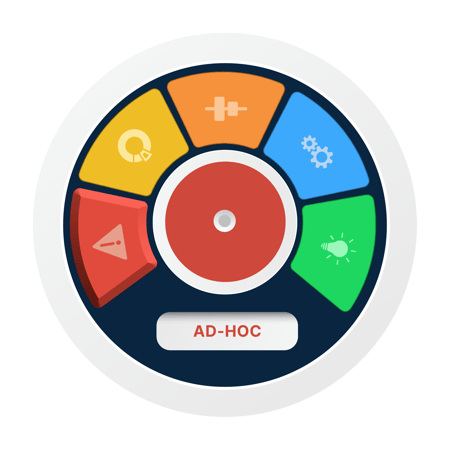
Together, the L1M3 framework evaluates observability maturity across:
This structure provides a clear, actionable view of the current state and a roadmap for continuous improvement.
RISK - high risk to the business due to a lack of tools, poor visibility, and excessive outages poor change management, ineffective audit and reactive incident response.
SILOED - Silos at their worst, failing to leverage the inherent strengths of IT teams. Fragmented tools, limited correlation, difficulty sharing, persistent security risks.
NOISE - Substantial investment in tools, and improved coverage, but often still siloed. Too much noise, limited resiliency, overlapping tools, excessive licensing, and operational costs. Still gaps in compliance and remediation.
CORRELATION - Tools deployed optimally, integrated & correlated, with shared visibility creating fully-meshed silos. Most easily achieved via SolarWinds AppStack™ and PerfStack™ as part of SolarWinds Hybrid Cloud Observability.
OUTCOMES - IT helps to drive business outcomes via effective analytics and business intelligence. Powered by data you can trust, facilitating improved planning for budgets, forecasts, training, and more.
Understanding key stakeholders and business services. What tools do they use? Who has access? What do they see? How do they use it? How will we make it better?
Becoming feature complete. Ensuring you know what your tools can do and you are using the features you want. Tool rationalization to reduce costs by eliminating redundant tools.
Gathering the right data, logs, traces, and metrics to deliver both application performance and user experience, while building the foundation for robust data analytics.
Configuration security for audit, remediation, and change management. Operational security, and event-based monitoring with automated response and incident management.
Beginning with native correlation between tools and extending to API-based integration between tools combined with SDK-based automation to enable full scalability.
Intelligent dashboards, integrated solutions for data-driven business decisions that enable improved forecasting and business predictability.
The foundation of modern ITOM SolarWinds Service Desk, SolarWinds Web Help Desk, ServiceNow, and other 3rd party solutions
The reason IT organizations exist SAM, VPM, Pingdom, AppOptics, NTA, VNQM, NPM, QoE, Log Analyzer, SEM, SCM
Legacy, cloud and hybrid foundation of application delivery NPM, SAM, AppOptics, NTA, Log Analyzer, SEM, SCM, ARM
The ‘base’ of modern applications SAM, SQL Sentry, DPA, DPM, NTA, Log Analyzer, SEM, SCM
The ‘hosts’ of modern infrastructure NPM, SAM, VMAN, Log Analyzer, SEM
Legacy and cloud NPM, VMAN, SRM, Log Analyzer, SEM
The transport and the services NPM, SAM, NVM, NTA, IPAM, UDT, Log Analyzer, SEM
By applying observability best practices through the L1M3 framework, organizations gain:
Clear visibility into current maturity and gaps
Prioritized, practical improvement initiatives
Alignment between tools, teams, and outcomes
A structured path toward automation, AIOps, and intelligent operations
Rather than chasing tools or trends, L1M3 ensures every step forward delivers measurable value.