
/loop1.com/Images/bigpanda-platform-overview-hero.png.webp)
Enterprise IT has spent the last decade building better visibility. The next decade will be defined by what organizations do with that visibility.
For many organizations, the journey has been familiar. First came monitoring platforms that alerted teams when infrastructure failed. Then observability expanded that view, bringing together metrics, logs, traces, applications, cloud environments and digital services into a more complete picture of operational health. More recently, AIOps promised to reduce alert noise, correlate events and help operations teams understand what was happening across increasingly complex environments.
Those investments have delivered genuine value. Yet despite better visibility than ever before, many IT teams still face the same daily challenges:
- Thousands of alerts requiring manual investigation
- Growing operational complexity without larger teams
- Knowledge trapped across multiple tools and subject matter experts
- Too much time spent understanding incidents, and not enough time resolving them.
The challenge today is no longer collecting more operational data. It's transforming that data into intelligent action.
That's why many organizations are now looking beyond traditional AIOps toward the next evolution of IT Operations: Agentic IT Operations.
AIOps has reached an inflection point
For several years, AIOps has focused on helping operations teams manage increasing volumes of operational data. By correlating alerts, identifying relationships between events, and reducing duplicate notifications, AIOps significantly improved signal-to-noise ratios across enterprise environments.
This represented an important step forward. Instead of reviewing thousands of unrelated alerts, operators could investigate a much smaller number of meaningful incidents.
But while AIOps became better at organizing information, people remained responsible for almost everything that happened afterward.
Operations teams still needed to:
- Gather context from multiple systems
- Decide which incidents mattered most
- Determine root cause
- Identify the correct runbook
- Coordinate response activities
- Escalate when specialist knowledge was required
In other words, AIOps improved decision support, but it rarely automated decision execution.
As infrastructure continues to expand across cloud, hybrid environments, SaaS applications and distributed architectures, this distinction has become increasingly significant. Organizations aren't struggling because they lack visibility. They're struggling because humans are still expected to do most of the operational reasoning.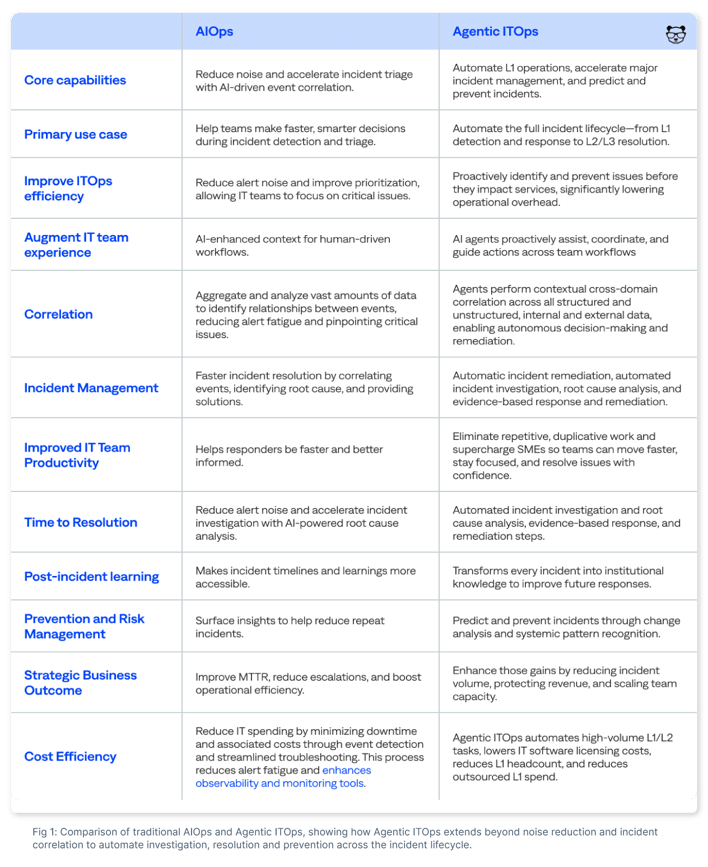
The observability gap
Observability has become the foundation of modern IT operations. It provides comprehensive visibility across infrastructure, applications, cloud services, and user experience.
It answers important questions like:
- What is happening?
- Where is it happening?
- When did it start?
- What changed?
Those capabilities are essential. But a gap remains between knowing something happened and knowing what to do next. This is the observability gap.
Many organizations still rely on people to bridge that gap manually. When an alert is raised, operators often need to move between multiple dashboards, search logs, review recent changes, consult documentation, message colleagues, and escalate to subject matter experts before they have enough context to understand the issue and determine the appropriate response. Only then can meaningful action begin.
This manual investigation consumes valuable time, particularly during major incidents, where every minute of delay increases the impact on customers, employees, and the business. Despite significant investments in observability, too many teams still spend more time gathering information than resolving the incident itself.
Why context changes everything
One of the recurring themes throughout modern IT Operations is context. Individual alerts rarely tell the whole story.
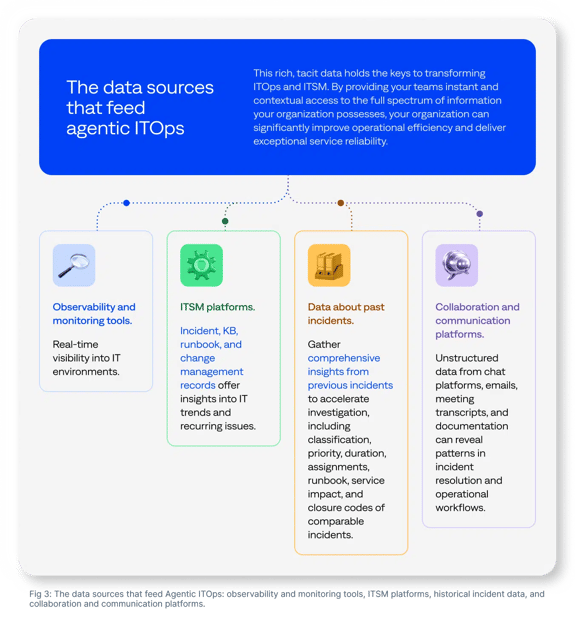
Understanding an incident requires combining information from multiple sources:
- Infrastructure monitoring
- Application performance
- Configuration data
- Service topology
- Change history
- ITSM platforms
- Knowledge articles
- Previous incidents
The challenge is that this information often lives across multiple disconnected systems. Engineers become the integration layer. They manually assemble context before they can make informed decisions. This process is difficult to scale.
As organizations continue adopting cloud-native technologies, microservices, and increasingly distributed architectures, operational context becomes even more fragmented. The opportunity lies not in creating more dashboards, but in automatically connecting existing knowledge.
Enter Agentic IT Operations
Agentic IT Operations represents a shift from passive intelligence to active assistance. Rather than simply identifying incidents, AI agents can begin contributing throughout the operational lifecycle.
They can:
- Evaluate change risk before deployment
- Correlate events into meaningful incidents
- Enrich incidents with relevant context
- Recommend appropriate actions
- Execute approved operational workflows
- Assist escalation
- Continuously learn from previous outcomes
Importantly, this isn't about replacing IT professionals. It's about removing repetitive manual work so specialists can focus on higher-value activities. Just as industrial automation didn't eliminate manufacturing expertise, Agentic IT Operations augments operational teams rather than replacing them.
Humans remain responsible for governance, oversight, and strategic decision-making. AI accelerates execution.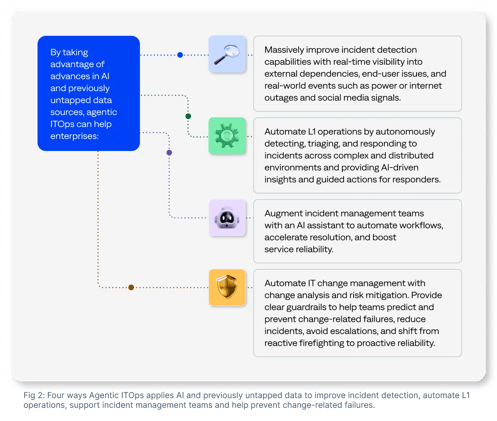
Preparing for Agentic IT Operations
Perhaps the biggest misconception surrounding AI in IT Operations is that organizations require perfect data before they can begin. In reality, most enterprises are already much closer than they think.
Organizations that have invested in monitoring, observability, and operational maturity have already completed much of the hard work. The next step isn't replacing existing investments. It's building upon them.
A practical roadmap often looks like:
- Strengthen observability
- Reduce operational silos
- Improve data quality over time
- Connect operational context
- Introduce AI-assisted workflows
- Expand automation where appropriate
Agentic IT Operations should be viewed as an evolution, not a replacement.
Technology alone isn't enough
Technology enables transformation. People deliver it. Throughout our work with enterprise organizations, one message consistently emerges: successful AI adoption depends just as much on operational maturity as it does on technology selection.
Organizations need:
- Clear operational processes
- Well-defined governance
- Cross-functional collaboration
- Executive sponsorship
- Confidence in automation
Technology without process simply automates inefficiency. Likewise, process without intelligent technology struggles to keep pace with modern operational complexity.
The strongest outcomes come from aligning people, process, and technology around shared operational goals.
The next chapter of IT Operations
Monitoring changed how organizations detected problems. Observability changed how they understood problems. AIOps changed how they organized operational data.
Agentic IT Operations has the potential to change how organizations respond to, and increasingly prevent, problems altogether.
For enterprise IT leaders, the question is no longer whether AI will influence operations. The question is how to build upon today's observability investments to prepare for tomorrow's intelligent operations. Organizations don't need to start again. They simply need to take the next step.
If you'd like to explore these ideas in more detail, including practical examples of how organizations are applying Agentic IT Operations today, watch our recent webinar featuring BigPanda. You'll hear how observability, AI, and operational context are coming together to help IT teams reduce alert fatigue, accelerate incident response, and build more resilient operations.
Also available:
Download the presentation slides
Book a complimentary Strategy Session with a Loop1 consultant
/loop1.com/Profile%20Pictures/Kris.png)